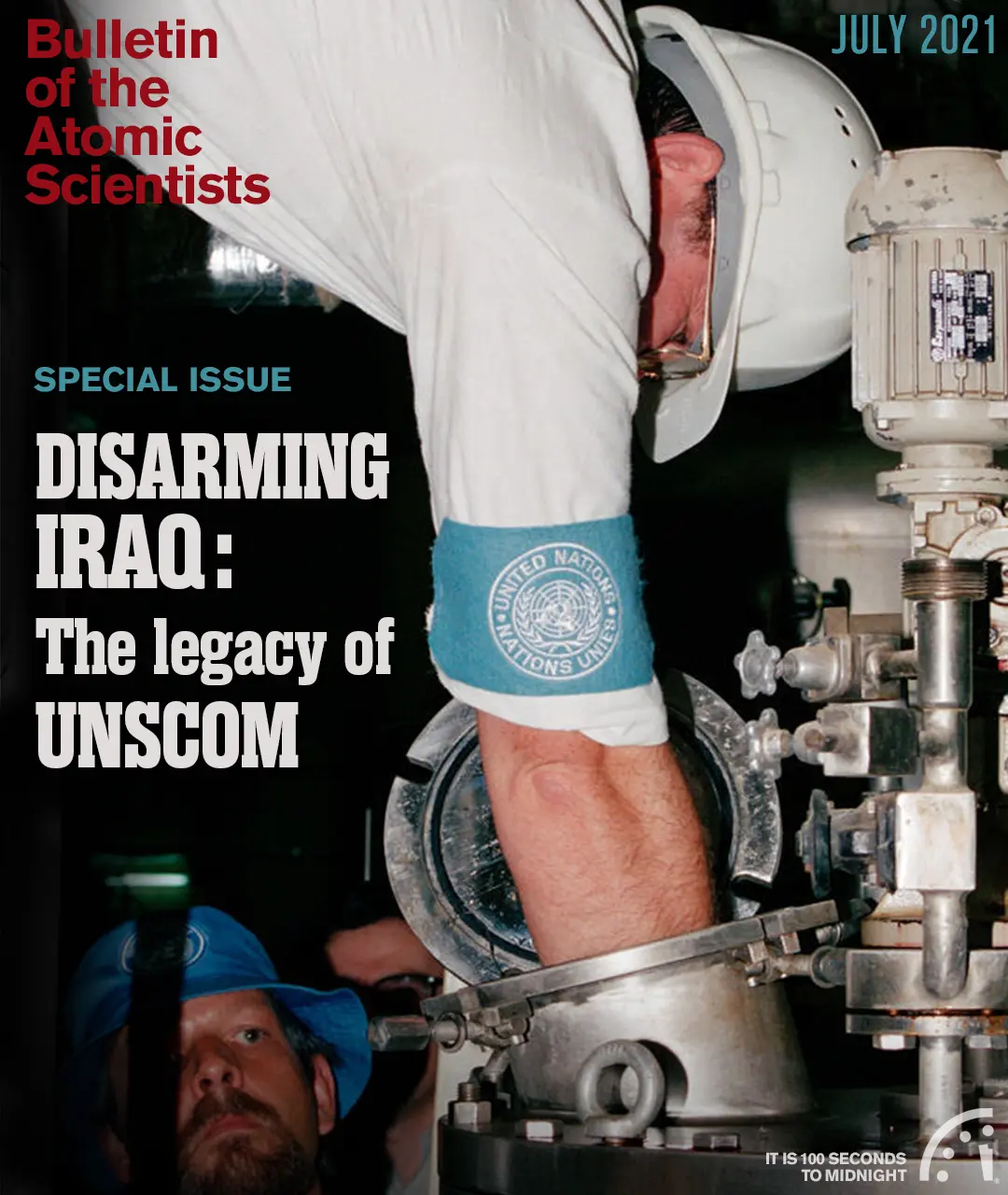
Disarming Iraq: The Legacy of UNSCOM
Introduction: UNSCOM and the future of WMD verification
Henrietta Wilson & Filippa Lentzos
UNSCOM remains relevant to contemporary efforts to minimize the risks of biological weapons. It faced enormous challenges in fulfilling its mandate—in the form of an Iraq determined to obstruct the international inspections—but its efforts nevertheless showed that internationally verified elimination of weapons of mass destruction is technically possible.
Rolf Ekéus
In this article, Rolf Ekéus, Swedish ambassador and UNSCOM executive chair from 1991 to 1997 gives his perspective on the UNSCOM process.
Puzzling out the Iraqi biological weapons program
David R. Franz
In this article, the former biological chief inspector for the UN Special Commission on Iraq from 1993-1995 recounts his efforts during two missions to locate biological weapons and biological weapons facilities in the wake of the First Gulf War.
Monitoring Iraq’s dual-use capabilities: An interview with Gabriele Kraatz-Wadsack
Filippa Lentzos
In this interview, a former biological weapons chief inspector for UNSCOM describes the importance of biological monitoring in Iraq, its challenges and successes.
UNSCOM: A successful experiment in disarmament
Åke Sellström
In this article, a former chemical and biological chief inspector for the UN Special Commission on Iraq from 1996-1998 concludes that the UNSCOM experience was a successful full-scale experiment in disarmament that uncovered and destroyed the infrastructure of the Iraqi bioweapons program. The UNSCOM experience, however, also illustrated the limitations of inspection methods, especially when it comes to small-scale activities in a distrusted country.
The many lessons to be drawn from the search for Iraqi WMD
Terence Taylor
After the Gulf War, Terence Taylor served on the UN Special Commission investigating weapons of mass destruction programs in the country. Technical expertise in weapons inspections, an understanding of global trade, and a knack for the element of surprise helped Taylor and other weapons inspectors discover, among other things, the existence of Iraq’s biological weapons program.
Perspectives on UNSCOM and UNMOVIC: An interview with Nikita Smidovich
Henrietta Wilson
In this interview with Henrietta Wilson, a researcher at SOAS University of London, Nikita Smidovich details the lessons that the UNSCOM experience can teach those who undertake weapons of mass destruction verification efforts today.
Some long-term effects of UNSCOM: People are important, or, therein lies much of the problem
Charles A. Duelfer
In this article, Charles A. Duelfer, Deputy Executive Chair of UNSCOM, 1993-1998, and Head of the Iraq Survey Group, 2004-2005, finds that UNSCOM demonstrated the value of access to individuals in achieving monitoring goals. A vital aspect of UNSCOM’s inspection authorities (arguably the most important) was the access to interview identified individuals. “Experts talking to experts” produced data and intangible, but critical, confidence in the weapons of mass destruction declarations of Iraq.
How countries can build on UNSCOM’s legacy to solve today’s problems
Ioan Tudor
In this article, the author, who was chief of the WMD Branch at the UN Office for Disarmament Affairs, explains how UNSCOM provided a foundational example of multilateral efforts to prevent the spread and use of weapons of mass destruction and why it is incumbent on all countries to work together to follow and build on that example today.
A perspective on UNSCOM culture
Tim Trevan
In this article, the author—who served as special adviser to UNSCOM’s executive chair and spokesperson for UNSCOM for nearly four years—focuses on the way in which UNSCOM’s organization and culture evolved to adapt to its mission to destroy, remove, and render harmless Iraq’s weapons of mass destruction and its long-range missiles.
UNSCOM’s work to uncover Iraq’s illicit biological weapons program: A primer
Stephen Black, Henrietta Wilson & Filippa Lentzos
In this article, the authors offer a primer of sorts that outlines UNSCOM’s historical context and the logistics of its work—central aspects contributing to Special Commission’s successes in searching for Iraq’s hidden biological weapons program.